Why Is My Fridge Not Cooling? 9 Causes & Fixes (2026)
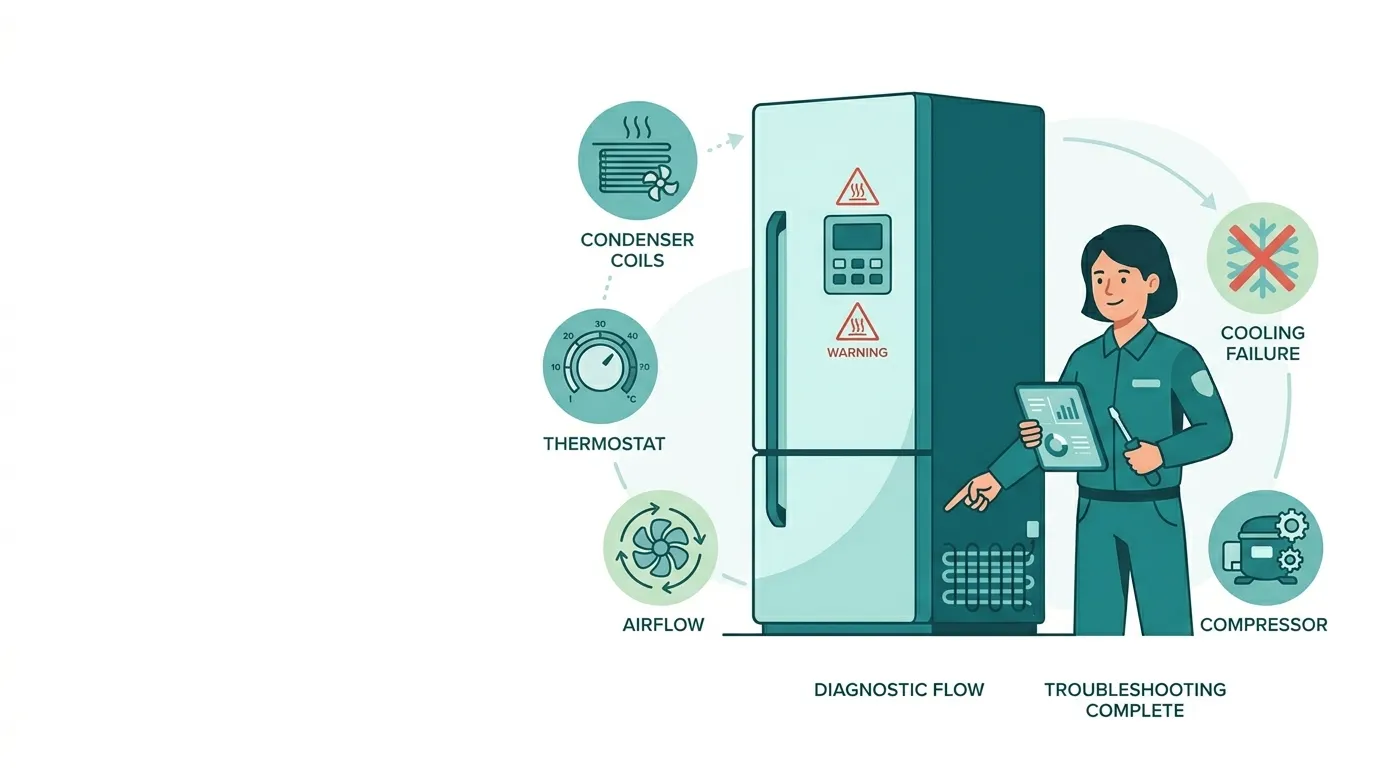
The fridge is the only appliance in your home that runs non-stop 24 hours a day, 365 days a year. So any cooling fault isn't just a nuisance — it's a direct threat to your food and medicine, especially in Riyadh's heat where food spoils fast. The good news: many causes of lost cooling can be diagnosed yourself before calling a technician, and some are fixed in minutes. This guide covers 6 common causes of a fridge not cooling, with a practical explanation and fix for each.
Quick answer
The most common causes of a fridge or refrigerator not cooling: a wrong temperature setting, ice build-up on the evaporator, a faulty cooling fan, low freon, a weak compressor, or worn door gaskets. Start by checking the temperature setting, that the rear vents are clean, and the fridge isn't overpacked; if it persists, it's likely a fan, gas or compressor fault needing a certified technician. If the freezer cools but the fridge doesn't, the cause is usually the fan or an ice-blocked air duct.
| Symptom | Most likely cause | Fix |
|---|---|---|
| Whole fridge suddenly warm | Wrong setting / low gas / compressor | Check setting, then call a technician |
| Freezer cold, fridge warm | Faulty fan or ice-blocked duct | Replace fan / defrost |
| Fridge cold, freezer not freezing | Low gas or weak compressor | Check gas & compressor |
| Ice build-up that won't melt | Defrost system fault | Replace defrost timer/heater |
| Weak cooling, high bill | Worn door gasket | Replace the gasket |
'Al-barrad' won't cool — what's the cause? (the same fault, Gulf term)
Every day we get calls saying 'al-barrad won't cool' and others saying 'the fridge isn't cooling'. The word differs between Riyadh, the Gulf and the Levant, but the appliance is the same, the fault is the same, and the fixes explained in this guide apply to both cases literally. So if you landed here searching why your barrad stopped cooling, you're in exactly the right place.
The realistic ranking of why a barrad stops cooling, as we see it in Riyadh homes, from most to least common: first, dust build-up on the rear condenser coil (very common in Riyadh specifically because of sandstorms, and it stops the fridge expelling heat), then a failed internal distribution fan, then a defrost system fault, then worn door gaskets, then low freon, and finally the relay or compressor. Note that the first four causes — the overwhelming majority — are simple and inexpensive to fix.
And before calling any technician, check these four things yourself in five minutes: has the temperature dial been changed by accident? Is the fridge pressed against the wall with no ventilation gap of at least 10 cm? Is its back covered in a thick layer of dust? Do the doors seal tightly? Half the cases that reach us are solved by these four checks alone.
How does a fridge cool? A quick understanding
A fridge works on the same principle as an AC: refrigerant circulates through the compressor and evaporator to move heat from inside the fridge to the outside. A small fan distributes cold air between the freezer and fridge, and a defrost system prevents ice build-up on the evaporator. Understanding these four parts — compressor, evaporator, fan, and defrost system — helps you quickly pinpoint the fault.
1. Temperature setting and overpacking
Before anything, make sure the temperature dial wasn't accidentally changed to a warm setting — a family member often nudges it unintentionally. Also ensure the fridge isn't so packed that cold air can't circulate, and that hot food isn't placed directly inside. These are simple things but responsible for a large share of weak-cooling complaints.
2. Ice build-up on the evaporator
A thick ice layer on the evaporator acts as insulation that blocks cold airflow into the fridge. The cause is often a fault in the auto-defrost system (timer or defrost heater). If you notice excess ice, empty the fridge and turn it off for hours until the ice melts, then call a technician to inspect the defrost system.
3. Faulty cooling fan — freezer works but fridge doesn't cool
The telltale sign of this fault: the freezer cools well while the fridge stays warm (the classic 'freezer works but fridge doesn't cool' complaint). The cause is that the fan responsible for pushing cold air from the freezer to the fridge has stopped or weakened, or ice has blocked the air duct between the two sections. Replacing the fan, or defrosting and fixing the defrost system, restores correct cold distribution between the two sections.
The reverse case: fridge cools but freezer doesn't freeze
Sometimes the problem is reversed: the fridge cools but the freezer won't freeze properly. This is often an early sign of low freon or a weakening compressor, because the freezer needs a lower temperature and is affected first when the cooling cycle weakens. Don't ignore this sign; an early check of gas pressure and the compressor saves you spoiled food and a bigger cost later.
4. Low freon
Low gas from a leak gradually weakens cooling until the fridge becomes warm. As with ACs, refilling alone isn't enough; the leak must first be located and repaired, then recharged to the correct amount — precise work done by a specialist with the right tools.
5. Weak compressor
The compressor is the fridge's heart that pumps the gas. Its weakness or failure means weak or no cooling, and you may hear a hum or notice the compressor is very hot. This is one of the costliest faults, so it must be diagnosed precisely: sometimes the issue is a simple relay that can be replaced cheaply instead of the whole compressor.
6. Worn door gaskets
The door gasket seals the fridge and prevents cold air from leaking. Over time it cracks or loses elasticity, so warm air continuously enters, the power bill rises, and the fridge struggles to keep cold. A simple test: place a sheet of paper between the door and frame and close it; if the paper slides out easily the gasket needs replacing — a simple, effective fix.
7. The fridge isn't cooling at the bottom but the freezer is fine
One of the most useful things for remote diagnosis is telling us exactly where the fridge loses its cold, because the warm spot points straight to the faulty part. In most no-frost fridges, cold air enters through vents at the top of the compartment then descends gradually. So:
- Bottom shelves warm, top shelves cold: cold air arrives but too weakly to reach the bottom — usually a weak fan or ice partially blocking the air duct.
- Top shelves warm, bottom relatively cold: the upper distribution vents are directly blocked — often by a food container pushed to the back covering the vent, the simplest cause of all.
- Fridge warm at both bottom and top while the freezer is excellent: a complete loss of airflow — a fully stopped fan or a duct blocked by a block of ice.
- Only the crisper drawer is warm or freezing: a humidity-slider setting issue for that drawer, not a cooling fault.
A simple practical test before calling us: open the fridge door and hold your hand in front of the upper air vents. If you feel a clear cold draught, the fan works and the problem is the amount of cold itself (gas or compressor). If you feel no draught at all, the problem is the fan or a blocked duct. This single piece of information cuts half the visit time.
8. Why the ice in the fridge won't defrost (defrost system fault)
Every modern fridge has an automatic defrost system that runs several times a day silently: cooling pauses for minutes, a small heating element behind the freezer's inner panel warms up to melt ice built up on the evaporator, and the water drains through a small tube into a tray above the compressor to evaporate. When this cycle fails, ice keeps accumulating until it forms a wall that fully insulates the evaporator — and cooling stops even though the compressor runs and the gas is fine.
The system has three parts, any of which may be the culprit: the defrost heater (most common), the timer that decides when the cycle starts, or the thermal sensor (thermostat or thermal fuse) that stops the heating. Diagnosing which one has failed needs a meter, but replacing any of them is far cheaper than most people expect — and far cheaper than a new fridge.
A telltale sign that confirms the diagnosis: if you switch the fridge off completely for 8–12 hours until all the ice melts, then turn it on and it cools excellently for several days before gradually worsening again — that strongly confirms the defrost system is the fault, not the gas or compressor. Avoid using a knife or any sharp tool to chip the ice; puncturing an evaporator tube turns a simple fault into an expensive repair.
9. The fridge motor won't start, or it runs but doesn't cool
These are two entirely different complaints despite sounding similar, and telling them apart is easy by listening. Get close to the back of the fridge and listen:
- No sound at all while the interior light works: the compressor isn't starting. The most common cause is the start relay or the start capacitor — a relatively cheap small part, not the compressor itself as many assume.
- A short hum then a stop, repeating every few minutes: the compressor tries to start and fails, usually cut off by the thermal overload. Same suspects: relay, capacitor, or compressor windings beginning to weaken.
- The compressor runs with a normal continuous sound but there's no cold: the cycle runs but there's nothing to pump — meaning low or no freon from a leak, or a blockage in the capillary tube.
- The compressor runs non-stop and never cuts off: the fridge never reaches the target temperature — usually partial gas loss, worn door gaskets letting warm air in continuously, or a rear condenser coil caked in dust.
The important message here: don't accept a 'the compressor is dead and needs replacing' diagnosis before the technician verifies the relay and capacitor in front of you with a meter. We see many cases every month that could have been solved with a small part, where the price of a whole compressor was paid.
How much does fridge repair cost in Riyadh?
What worries customers most before calling is the cost, so here's a realistic picture before you book. We show the final price after diagnosis and before work starts, and the diagnosis fee is credited toward the repair on approval:
| Fault | Approx. cost (SAR) | Worth repairing? |
|---|---|---|
| Door gasket | 120 – 250 | Always yes |
| Internal cooling fan | 150 – 300 | Always yes |
| Start relay or capacitor | 120 – 250 | Always yes |
| Defrost heater / timer | 180 – 400 | Yes |
| Gas leak repair + recharge | 250 – 500 | Yes if under 8 years old |
| Compressor replacement | 500 – 1200 | Compare with a new fridge |
The rule we honestly recommend: if the repair exceeds 40% of the price of a comparable new fridge and your appliance is over ten years old, replacement is wiser — and we'll tell you that frankly even if it costs us the job.
Tips to keep your fridge healthy
- Clean the condenser coil behind the fridge of dust every few months.
- Don't overpack the fridge in a way that blocks air circulation.
- Leave enough space between the fridge's back and the wall for ventilation.
- Avoid placing hot food directly inside.
- Periodically check the door gaskets and ensure a tight seal.
Fast fridge repair in Riyadh
Because every hour a fridge is down means risk to your food, we offer same-day fridge and freezer repair across all Riyadh districts, with accurate diagnosis, warrantied parts and a workmanship warranty. Whether the issue is the fan, gas or compressor, our team is ready to restore cooling fast. Reach us by call or WhatsApp.
💡 Related on our site: Need Refrigerator & Fridge Repair? Also browse AC Repair & Maintenance and AC Cleaning & Wash, and see our price guide. We serve all Riyadh districts including Al Malqa. To book, contact us or return to the homepage.
Need Refrigerator & Fridge Repair?
Our certified team is ready across all Riyadh districts.
Frequently asked questions
The most common causes of a fridge or refrigerator not cooling: a wrong temperature setting, ice build-up on the evaporator, a faulty cooling fan, low freon, a weak compressor, or worn door gaskets. Start by checking the temperature and ventilation; if it persists, call a technician.