Why Do Air Conditioners Explode? 7 Real Risks & How to Prevent Them
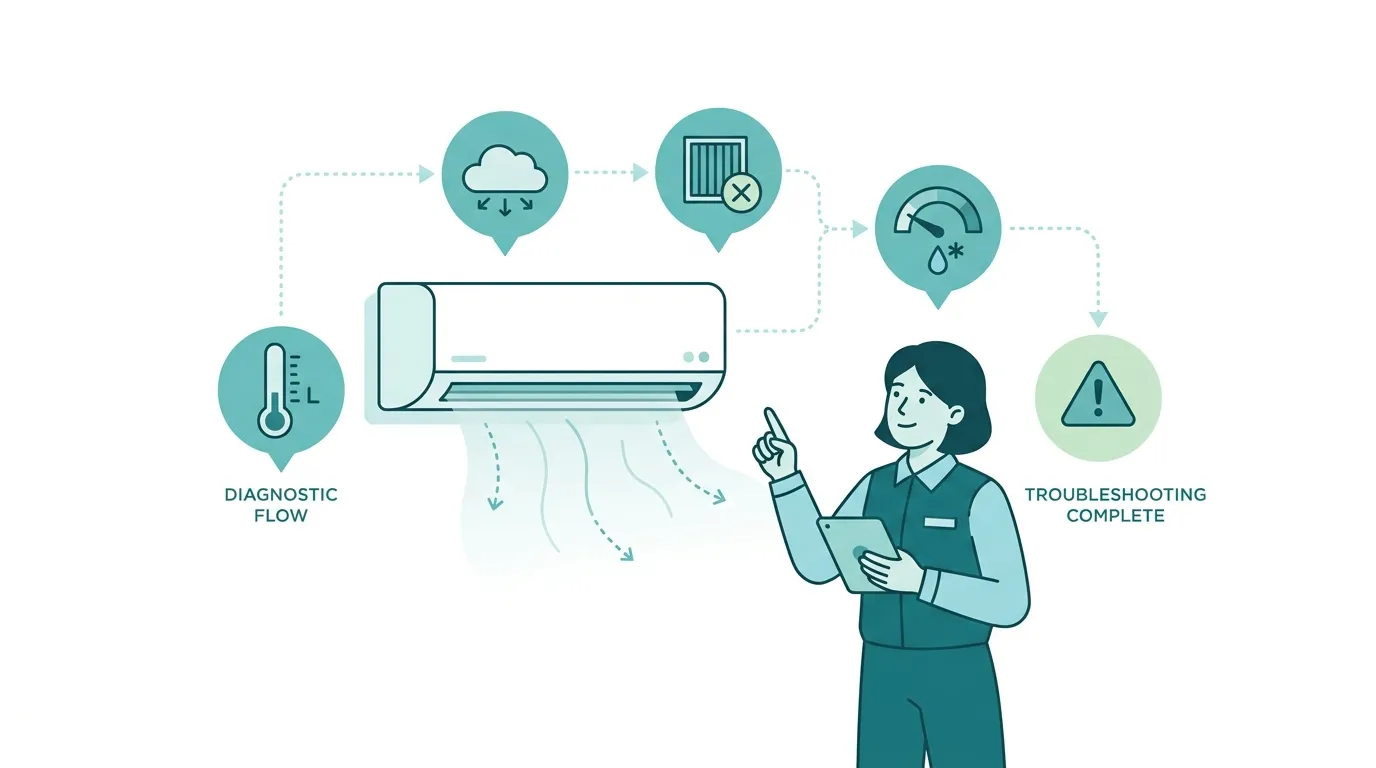
Many Riyadh residents search for 'why do air conditioners explode' after hearing a news story or seeing a video clip, and the question is entirely legitimate — especially with ACs running long continuous hours in a summer above 45°C. In this guide we answer frankly and without alarmism: what actually explodes in an AC, what burns, what signs precede an incident by days or sometimes weeks — and how to prevent it with simple measures.
Quick answer
A literal AC explosion — the whole unit rupturing — is very rare. Far more common is a single component bursting with a loud bang and smoke, the prime candidate being the capacitor, followed by a contained electrical fire at the terminal block. There are seven real causes behind these incidents: overcharged refrigerant, a blockage in the cooling circuit that raises pressure, a swollen worn-out capacitor, weak electrical connections or undersized cable, neglecting outdoor-unit cleaning until it overheats, unprofessional repair with poor brazing, and using a refrigerant that doesn't match the unit's type.
What actually explodes inside an AC?
To understand the risk precisely, we must distinguish three types of incident that people lump together under 'explosion':
| Incident type | What actually happens | How common |
|---|---|---|
| Capacitor burst | A loud pop, smoke and a sharp smell, and the AC stops cooling. Damage is usually contained inside the outdoor unit. | By far the most common |
| Electrical fire at the terminal block | Insulation burning around the terminals from a loose connection and rising resistance, with a burnt-plastic smell that can spread to the cable. | Common |
| Tube or joint rupture under pressure | A sudden gas discharge with a sharp sound, occurring when high pressure meets weak brazing or a blockage. | Rare |
| Compressor explosion | The compressor shell itself ruptures — requires exceptional pressure with every protection failing at once. | Very rare |
The reassuring message: serious incidents require several failures combining at once, which doesn't happen to an AC that receives periodic maintenance from a competent technician. The cautionary message is that the first two types — capacitor and terminal block — are entirely possible in any neglected AC, and both give an early warning before the incident.
1. Overcharged refrigerant — the most dangerous and most neglected cause
Every AC unit carries a small rating plate specifying the refrigerant charge in grams or kilograms precisely. Exceeding it sharply raises discharge-side pressure, forcing the compressor to run under constant strain with rising temperature, pushing the system toward the safety valve's limit. The problem is that much charging is done 'by feel' or by watching a single pressure gauge, or a new amount is added on top of the old without evacuating. An important note here: topping up every season without finding the leak source isn't an economical fix but an accumulating risk — each refill increases the chance of getting the quantity wrong.
2. A blockage in the cooling circuit
If the capillary tube or filter drier becomes blocked by deposits or moisture frozen inside the circuit, the compressor keeps pumping toward a closed path and pressure rises rapidly ahead of the blockage. This specific situation is what can lead to a joint or tube rupturing. The telltale sign beforehand: the AC repeatedly cuts off automatically minutes after starting, with abnormal heat in the outdoor unit — which is exactly what the protection system does to prevent an incident. Don't ignore this repeated cut-off and never try to bypass the protection.
3. A swollen capacitor
The capacitor is a small cylinder storing a momentary charge that helps the compressor and fan start. Over years of high heat, the dielectric inside degrades and gases build up that bulge its metal casing. A swollen capacitor is a small time bomb: it can burst loudly and scatter its contents. The check is very simple and takes under a minute — the technician looks at its top surface, and if it's domed rather than flat it must be replaced immediately. This part is relatively cheap, and replacing it preventively every few years is one of the best safety investments in an AC.
4. Weak electrical connections and undersized cable
This is the number-one cause of electrical fires in ACs, and it's purely an installation error. When a cable end isn't tightly clamped in the terminal block, resistance rises at the contact point generating intense local heat that gradually burns the insulation until it ignites. The indicator you can spot yourself: blackening or charring around the terminals, or the socket or cable being hot to the touch. Likewise, using cable with a smaller cross-section than the AC's load — a common error in rushed installations — makes the cable itself heat along its length. Always ensure the AC has its own breaker of the correct rating and isn't branched off a lighting circuit.
5. Neglecting outdoor-unit cleaning
Dust in Riyadh isn't a cosmetic matter but a safety one. The outdoor unit expels the entire circuit's heat through the condenser fins; if dust coats them it acts as an insulating blanket that blocks heat rejection, so both pressure and compressor temperature rise. Add to that placing the unit in a narrow light-well or behind a barrier that prevents air renewal, so it re-ingests its own hot air. The result is permanent operation near the maximum pressure limit — the perfect environment for capacitor or compressor failure. Cleaning the outdoor unit twice a year and leaving ventilation clearance around it is a simple preventive measure that greatly reduces this risk.
6. Unprofessional repair and poor brazing
Every brazed joint in the copper lines is a potential weak point unless done at the correct temperature, with the right filler, and under a nitrogen purge that prevents oxide forming inside the tube. Rushed brazing produces a joint that looks sound but is brittle under constant pressure and vibration, and may fail months later. Likewise, oxide flakes formed by brazing without nitrogen shed inside the circuit and later block the capillary tube — meaning a poor repair itself creates risk cause number 2.
7. Using a non-matching refrigerant
Every AC has a specific refrigerant marked on its plate — R22, R410A or R32 — and each type has different operating pressures and a different compatible oil. Filling one type in place of another, or mixing two in the same circuit, creates pressures the tubes and valves weren't designed for and ruins the oil that protects the compressor. Always ask the technician which refrigerant they'll charge and compare it with the unit's plate before they start — one question that saves you a major failure.
7 early warning signs that precede an incident
The good news is that in most cases an AC doesn't fail suddenly without warning. These signs appear days or weeks before an incident, and each one alone is sufficient reason to switch the AC off at the breaker and call a technician:
- A burning or burnt-plastic smell on start-up — the most serious sign of all and it cannot wait.
- Crackling sounds or an unusually loud hum from the outdoor unit.
- The breaker tripping repeatedly specifically when the AC runs.
- Abnormal heat in the cable, socket or breaker when touched.
- Visible blackening or charring around the terminals or on the cable.
- The AC cutting off automatically minutes after starting, repeatedly (the protection is working).
- The capacitor's top surface domed or swollen instead of flat.
What to do immediately when a warning sign appears
- Switch the AC off at the breaker in the main panel, not with the remote — the remote doesn't cut power to the unit.
- Don't spray water on any electrical part, no matter how much smoke you see.
- Open windows to ventilate and keep children away from the area.
- Don't restart it 'just to test' even if the smell has gone or the noise stopped.
- Call a certified technician to inspect the terminal block, capacitor, gas pressure and windings before any operation.
How to prevent the risk in the first place
Prevention here is simpler and cheaper than expected. Four measures suffice: clean the outdoor unit at least twice a year and leave ventilation clearance around it; check the capacitor and electrical connections during every periodic maintenance visit; repair the gas leak source instead of topping up every season; and ensure the AC has its own breaker of the correct rating and cable of adequate cross-section. Together these four cover the vast majority of the seven causes above.
AC safety inspection in Riyadh
If you've noticed any of the seven warning signs, or a year has passed without checking your AC's connections and capacitor, don't delay. We provide electrical-safety and pressure inspection for ACs across all Riyadh districts as part of a periodic maintenance visit: capacitor check, tightening terminals, measuring current draw, and verifying the gas charge matches the unit's plate. We show the price before starting and give a written workmanship warranty. Reach us by call or WhatsApp — your home's safety is worth one inspection a year.
💡 Related on our site: Need AC Repair & Maintenance? Also browse AC Cleaning & Wash and AC Water Leakage Fix, and see our price guide. We serve all Riyadh districts including Al Malqa. To book, contact us or return to the homepage.
Need AC Repair & Maintenance?
Our certified team is ready across all Riyadh districts.
Frequently asked questions
A literal AC explosion is very rare but not impossible. Far more common is a single internal component bursting — usually the capacitor — with a loud bang and smoke, or a contained electrical fire at the terminal block. A compressor or whole-unit explosion happens only when very high gas pressure combines with a blockage in the circuit and a missing safety valve.