AC Dripping Water Indoors: 8 Causes & the Permanent Fix (2026)
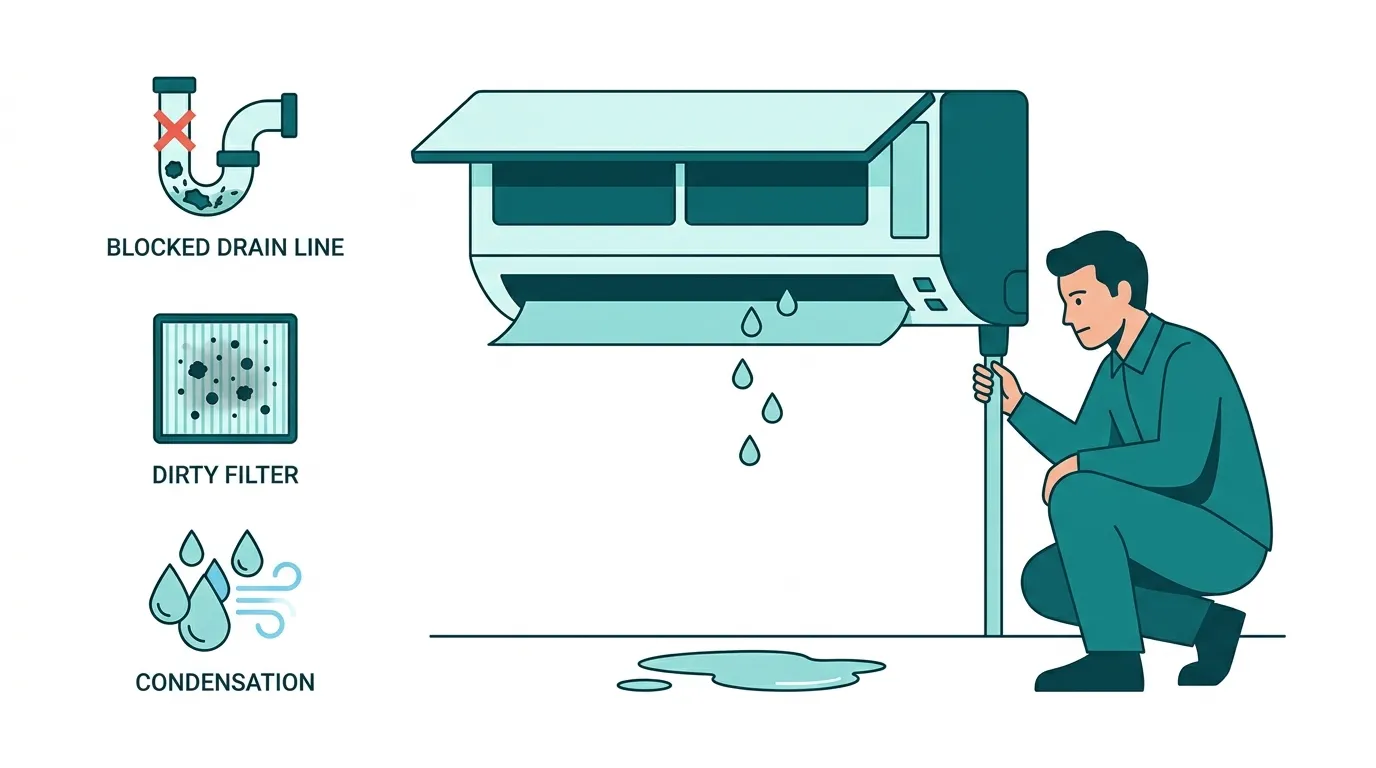
One of the most worrying sights is water dripping from your AC inside the room, or a damp patch spreading on the wall below the indoor unit. A water leak isn't just a nuisance — it can damage paint, plaster and furniture, and cause damp and mold that harm your home. The reassuring news: most AC dripping cases have clear, limited causes, many of which can be diagnosed quickly and fixed for good. This guide explains in detail why an AC drips water indoors, how to tell the cause, what you can do yourself, and when you need a technician.
Quick answer
The most common cause of AC dripping is a drain line blocked by dust and algae, followed by a wrong installation slope, then low freon that freezes the coil, then a full or cracked collection tray, then damaged copper-pipe insulation (sweating), then a blocked rear drain hole on a window AC, then a failed drain pump on a concealed unit, and finally a very low temperature setting combined with weak fan speed. The real fix is identifying the exact cause and treating it at the source: unclogging the drain, correcting the slope, repairing the gas leak, or cleaning the tray — not just wiping water every day.
A note on terminology: whether you say the AC is 'dripping', 'leaking water from the indoor unit', 'running water inside', or 'the climatiseur is streaming water' — these all describe the same fault, and the same diagnosis in this guide applies to all of them.
Where does the AC water come from in the first place?
Many wonder: why is there water in the AC in the first place? The answer is that while cooling, the AC pulls humidity from the room's air, which condenses on the cold coil into water droplets. Normally this water flows into a small collection tray and out through the drain hose to outside the home. Any disruption in this path — a blockage, wrong slope, or overflow — makes the water leak indoors instead of draining. Understanding this cycle helps you locate the problem.
1. Blocked drain line — the number one cause
Over time dust, algae and even small insects build up inside the drain hose, partially or fully blocking it. The water then can't find its way out and accumulates in the tray until it overflows indoors. This cause is responsible for the majority of dripping cases, especially in dusty Riyadh. The telltale sign: dripping increases the longer the AC runs.
The fix is clearing and cleaning the hose with pressure or specialized tools, then sanitizing it to prevent algae regrowth. The technician also checks that the hose end outside isn't blocked or kinked.
2. Wrong installation slope
The indoor unit must be installed with a very slight slope toward the drain side so water flows by gravity. If it's mounted perfectly level or with a reverse slope, water pools on the wrong side and leaks from the unit's edge. This is common with unprofessional installation, and the fix is re-adjusting the mounting slope — a good reason to choose an experienced installer from the start.
3. Low freon and a frozen coil
It may seem odd that low gas causes a water leak, but the mechanism is clear: low gas makes the coil extremely cold so ice forms on it, and when the AC stops this ice melts all at once in a volume that exceeds the tray's capacity, overflowing. The telltale sign here is ice on the pipes or coil along with weak cooling. The fix isn't just cleaning, but repairing the gas leak and recharging the correct amount by a technician.
4. Full or cracked collection tray
The plastic collection tray can fill with sediment, crack over time, or shift from vibration, leaking water before it reaches the drain. Cleaning the tray or replacing it when damaged stops the leak for good. The technician also checks the drain pump in ACs that have one.
| Cause | Telltale sign | Fix |
|---|---|---|
| Blocked drain line | Dripping grows the longer it runs | Clear & sanitize the hose |
| Wrong installation slope | Leak from the unit's edge | Re-adjust mounting slope |
| Low freon / frozen coil | Ice on pipes + weak cooling | Repair leak & recharge gas |
| Full / cracked tray | Constant leak, no ice | Clean or replace the tray |
Is it dangerous to run the AC while it's dripping water?
This is the most common question we get, and the straight answer is: yes, there's a real risk and it shouldn't be taken lightly. The leaking water inside the indoor unit passes centimetres from the electronic control board and the electrical terminals. Any contact can cause a short circuit that burns the board — one of the AC's most expensive parts — or trips your home's breaker. In rarer but real cases, water reaches a power socket on the wall below the unit.
The second risk is slower but certain: moisture. A wall that gets wet daily behind the unit grows black mold within one to two weeks in Riyadh's climate, and the plaster and paint absorb it, swell and flake off. Treating a mold-affected wall costs far more than clearing a blocked drain line.
As for 'is it okay to sleep while the AC drips?' — it's not advisable. While asleep you won't notice the wetness spreading, and the leak can run six to eight hours straight. If you must run it for one night before the technician arrives, use a safe temporary workaround: switch the AC to Fan mode instead of Cool. The fan alone doesn't chill the coil, so no condensation occurs and no water forms at all — you won't get cooling, but you completely avoid the damage.
What to do immediately when you see a leak?
- Turn off the AC to avoid more water and electrical damage.
- Place a container or towel to absorb water and protect the floor and furniture.
- Check if there's ice on the pipes (a sign of low gas).
- Inspect the drain hose end outside the home if possible.
- If the leak doesn't stop, call a certified technician and don't run the AC until fixed.
If the AC is dripping water, what should I do? DIY steps
Before calling a technician, there are four completely safe steps you can do yourself that resolve a fair share of simple cases:
- Trace the drain hose to its outlet outside the window or on the external wall, and make sure its mouth isn't blocked by dust, mud or an insect nest, and isn't submerged in standing water.
- Make sure the hose isn't kinked or pinched behind furniture or under a heavy object — a sharp bend alone is enough to trap the water.
- Remove and wash the filters; a clogged filter reduces airflow so the coil freezes, then melts all at once and overflows the tray.
- If there's visible ice, run the AC on fan-only for half an hour so the ice melts gradually instead of collapsing at once.
What you shouldn't do yourself: don't blow into the hose with your mouth (the algae inside are harmful), don't force a metal wire in (it punctures the hose so water leaks inside the wall), and don't remove the indoor unit's cover with the power connected. If the four steps don't work, the blockage is deep and needs specialist pressure or vacuum clearing.
The AC is dripping water from the outdoor unit — is that normal?
This is where a big confusion happens. Water dripping from the outdoor unit in cooling mode is completely normal and no cause for concern — that's the correct exit for condensate coming from inside. In fact, water stopping from the outdoor unit while the AC runs at full power is the worrying sign, because it means the water is trapped somewhere inside.
So when is an outdoor-unit leak abnormal? In two cases: first, if water comes from the unit's body rather than the bottom drain opening — this is usually condensation on pipes that have lost their insulation. Second, if the 'water' is oily, coloured or has a smell — that's compressor oil escaping with a gas leak and calls for switching the AC off immediately and calling a technician. In heating mode in winter, heavy water from the outdoor unit is also normal because the defrost cycle is running.
AC dripping by brand: Sharp, Carrier, Midea, Fresh, Gree
Many people search for 'Sharp AC dripping water inside', or Carrier, or Midea, assuming the fault is brand-specific. The reassuring technical truth: the condensation and drainage mechanism is essentially the same across brands, and the four causes above apply to all of them. But there are small practical differences worth knowing:
| Brand | Practical drainage note |
|---|---|
| Sharp | The collection tray is relatively narrow on some models, so it overflows faster at the slightest blockage — clearing it every 4 months helps. |
| Carrier | Very sensitive to installation slope; most dripping cases are caused by perfectly level mounting with no tilt toward the drain. |
| Midea | Some models have a self-dry mode on the remote that reduces moisture inside the unit after shutdown. |
| Fresh | The supplied drain hose is long and often left coiled at installation, creating a kink that traps water. |
| Gree / LG / Samsung | No fundamental difference; always start with the drain line, then the slope, then gas pressure. |
Bottom line: don't waste time hunting for a brand-specific fix. The model number is only useful to identify the tray shape and unit capacity, which is what we ask for when booking to speed up the visit — the diagnosis itself is the same.
Fixing split-AC dripping from the remote
There's no remote button that 'stops dripping' directly, but there are settings that noticeably reduce the amount of water formed. First, avoid setting the temperature to 16 or 18°C; the colder the coil, the more condensation. Stay at 22–24°C. Second, raise the fan speed to high instead of low; higher airflow stops the coil freezing. Third, if there's a 'Dry' or dehumidify mode, use it on humid days only since it's designed to drain moisture efficiently. Fourth, on Midea and some modern brands there's a 'Self Clean' or auto-dry mode that runs the fan for minutes after shutdown to dry the coil — enable it. These settings ease the symptoms but don't replace clearing a blocked drain.
Dripping by AC type: split, window, concealed
The AC type changes where to look. In a split AC (the most common in Riyadh) water appears at the indoor unit's edge or behind it, and the prime suspect is always the long drain hose running outside. A window AC should drain through a small opening in its rear base, and dripping inward usually means it was installed sloping toward the room instead of outward — or that the rear drain hole is clogged with dust, a very common case in Riyadh. A concealed (ducted ceiling) AC is the most dangerous because the leak shows up late as a stain on the gypsum ceiling after it has already pooled above, and it often relies on a small electric drain pump that can fail silently.
The AC produces no water at all — is that a problem?
The opposite question, but entirely legitimate. If the AC cools well and no water exits outside, that can be normal on Riyadh's extremely dry days when air humidity drops so low that condensation nearly disappears. But if 'no water' combines with 'no cooling' — a common complaint — that's an important diagnostic sign meaning the coil isn't getting cold at all, usually from severe freon loss or a compressor that has stopped. Here the absence of water isn't the problem but evidence of it. The third and most dangerous case: the AC cools but no water appears outside or inside — meaning water is collecting inside the wall or above the false ceiling through a punctured hose, and must be checked immediately before damage shows as cracked plaster.
Water droplets on the AC pipes and vents (sweating)
Not every water you see is a drain leak. If the droplets are on the copper pipes running between the two units, or on the air outlet and louvre blades, the cause is entirely different: sweating (surface condensation). A cold copper pipe that has lost its black insulation sweats exactly like a chilled water bottle, and the droplets gather and fall onto the floor or inside the wall. The fix here isn't clearing a drain but re-insulating the pipe with fresh thermal insulation — a simple, cheap job that's often neglected.
As for sweating on the outlet louvres, there are two common causes: a very low temperature setting combined with high humidity, or a dirty coil that disrupts cold-air distribution. Raise the temperature to 23°C and increase fan speed as a first step; if the sweating persists, the coil needs washing.
How much does AC leak repair cost in Riyadh?
Cost depends entirely on the cause, which is exactly why diagnosis before pricing is essential. We show the final price after identifying the cause and before work starts, and the diagnosis fee is credited toward the repair once you approve. Here's an approximate table to set a realistic expectation:
| Case | What's done | Approx. cost (SAR) |
|---|---|---|
| Blocked drain line | Pressure clearing + anti-algae sanitizing | 100 – 180 |
| Wrong installation slope | Remount with the correct slope | 150 – 300 |
| Dirty or cracked tray | Clean or replace the tray | 120 – 350 |
| Damaged pipe insulation (sweating) | Re-insulate the full line | 100 – 250 |
| Low / leaking gas + frozen coil | Locate leak, repair, recharge correct amount | 200 – 400 |
| Concealed-unit drain pump | Test or replace the pump | 250 – 500 |
The prices above are indicative for average residential cases in Riyadh and vary by unit type, ease of access and floor level. For full details see our pricing page.
How to prevent AC leaks in the future?
Prevention is simpler and cheaper than repair. Periodic AC cleaning every 3–4 months that includes clearing and sanitizing the drain prevents most leaks. Also ensure professional installation with the correct slope, and watch for any ice on the pipes as an early warning. Preventive maintenance extends your AC's life and spares you summer surprises.
AC leak repair in Riyadh
If your AC keeps dripping despite your attempts, it's best not to wait until the damage spreads. We offer same-day AC leak repair across all Riyadh districts, with accurate diagnosis of the leak source and a root-cause fix with warranty. Reach us by call or WhatsApp to book a fast appointment.
💡 Related on our site: Need AC Water Leakage Fix? Also browse AC Repair & Maintenance and AC Cleaning & Wash, and see our price guide. We serve all Riyadh districts including Al Malqa. To book, contact us or return to the homepage.
Need AC Water Leakage Fix?
Our certified team is ready across all Riyadh districts.
Frequently asked questions
The most common reason an AC drips water from the indoor unit is a drain line blocked by dust and algae, then a wrong installation slope, then low freon that freezes the coil. The fix is clearing the drain, correcting the slope, or repairing the gas depending on the cause.