Why Won't My AC Cool Even When Running? 11 Causes & Fixes (2026)
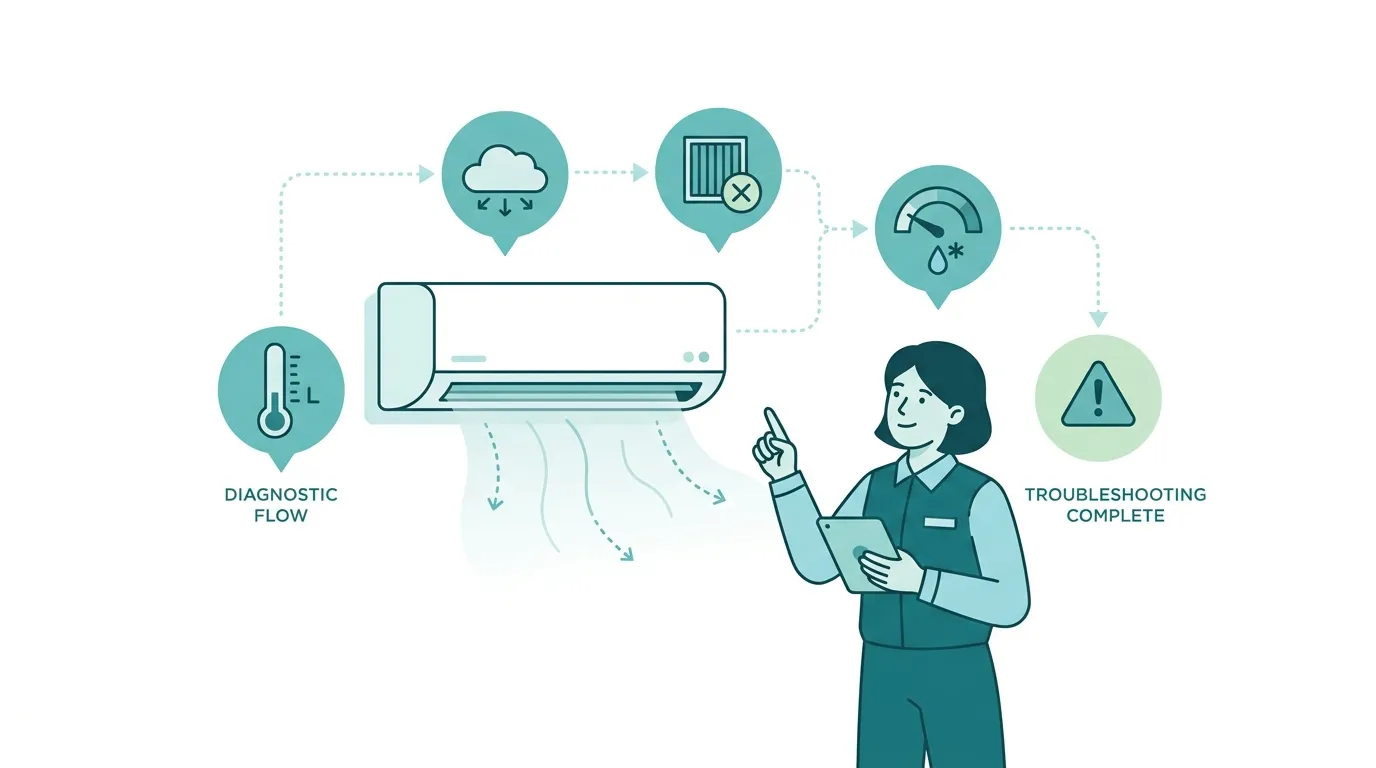
Picture coming home after a long day in Riyadh's 45°C+ heat, switching on the AC, and finding it runs and makes noise but the air coming out is lukewarm or warm. It's a frustrating situation thousands of residents face every summer. The good news: most causes of weak AC cooling are well known and fixable, and some you can handle yourself in minutes. In this complete guide we detail the top 7 reasons your AC isn't cooling despite running, with practical steps for each, and when DIY is enough versus when you need a certified technician.
Quick answer
The most common cause of an AC not cooling is dirty filters and low freon. Start by cleaning the filters, ensure the remote is set to 'Cool', and clear dust from the outdoor unit. If the problem persists after these steps, it's likely low or leaking gas, a frozen coil, or a weak compressor — faults that need a certified technician to inspect and fix safely.
How does an AC work? A quick understanding
Before diving into causes, it helps to understand the basic idea: an AC doesn't 'make' cold — it moves heat from inside the room to the outside via a refrigerant (freon) circulating between the indoor and outdoor units. The indoor unit absorbs the room's heat; the outdoor unit expels it. Any disruption in this cycle — gas amount, coil cleanliness, airflow, or the compressor that pumps the gas — directly affects cooling. This simple understanding makes diagnosis more logical.
1. Dirty filters — the first thing to check
Riyadh's dust and sandstorms clog AC filters astonishingly fast. A blocked filter stops air from passing through the coil, so cold airflow drops and the AC feels like it 'isn't cooling'. Worse, a dirty filter forces the AC to run longer for the same cooling, raising your power bill by up to 15%.
The fix is simple: remove the filter (usually behind the indoor unit's front cover), wash it with lukewarm water and mild soap, let it fully dry, then refit. Repeat every two weeks in summer. If the filter is torn or stiff, replace it. This single step resolves a large share of weak-cooling cases at zero cost.
2. Low freon or a leak
Freon is the heat-transfer medium. If it drops due to a leak, cooling weakens gradually until the air is lukewarm. A telltale sign of low gas is frost or ice forming on the copper pipes or the coil. Here's a point people often get wrong: refilling gas without fixing the leak is only temporary — the new gas leaks out within weeks, the problem returns, and you pay twice.
A certified technician measures gas pressure with a specialized gauge, locates the leak (often at joints or the coil), repairs it, then recharges the exact amount. Don't try refilling gas yourself; too much or too little harms the compressor, and handling refrigerant requires tools and expertise.
3. Dirty or frozen coil
The coil (heat exchanger) is where the gas exchanges heat with the air. Dust on its fins acts as insulation that blocks heat exchange, weakening cooling even when everything else seems fine. With low gas or poor airflow, the coil can freeze into a block of ice that stops cooling entirely.
If you see ice on the coil, turn off the AC and run the fan only until the ice melts, then call a technician. The root fix is steam-washing the coil to remove built-up dust, which noticeably restores cooling and is recommended twice a year in Riyadh.
4. Weak compressor — the heart of the AC
The compressor is the motor that pumps refrigerant through the whole cycle. When it weakens or fails, cooling stops or becomes very weak, and you may hear a buzz or the AC cuts off after minutes. Compressor faults are among the most complex and costly, so they must be diagnosed precisely: sometimes the issue is a simple capacitor that can be replaced cheaply, not the compressor itself. That's why specialist diagnosis saves you a lot of money.
5. Remote settings — don't rule out the obvious
Before calling any technician, check these simple points that make a difference:
- Ensure mode is 'Cool' (❄), not 'Fan' or 'Auto'.
- Set temperature to 22–24°C; a very low number may not help and raises consumption.
- Check the Timer or Eco mode isn't accidentally on.
- Replace the remote batteries if the signal is weak.
- Make sure fan speed isn't on 'Low' if you want faster cooling.
6. Blocked or dirty outdoor unit
The outdoor unit is responsible for expelling heat. If it's surrounded by heavy dust, leaves, placed in a tight unventilated spot, or exposed to direct sun all day, it can't expel heat efficiently and indoor cooling weakens. Ensure adequate clearance around the unit, clean dust and debris from the fins, and avoid placing anything that obstructs airflow around it.
7. AC undersized for the room
If the AC's tonnage is below the room size, it won't cool efficiently no matter how good its condition. As a rough rule, every 20–25 m² needs about one ton of cooling, with more capacity for sun-exposed rooms or large windows. If your AC runs non-stop and never reaches the set temperature, size may be the cause; consult a technician to pick the right capacity when replacing.
8. The AC cools but the cooling is weak — an important diagnostic difference
One of the most important questions we ask a customer before the visit: is the AC 'not cooling at all' or 'cooling but weakly'? The difference completely changes the suspect list and saves diagnostic time. When cooling is merely weak — the air is cold but not enough to cool the room — the cycle is working and the issue is its efficiency: clogged filters, a dirty coil, partial gas loss, an outdoor unit surrounded by dust, or an AC undersized for the room. But when there's no cold at all — the outgoing air is at room temperature — the cycle has stopped: complete gas loss, a compressor not running, or the AC is simply set to fan mode.
A precise practical test you can do in two minutes: run the AC at maximum cooling for ten minutes, then hold a thermometer (or even use your hand to compare) at the air outlet and then at the air intake. The normal difference between the two should be 8–12°C. If the difference is under 5°C there is a confirmed fault in the cycle — most likely low gas. And if the difference is near zero, the compressor isn't running. Telling us this when booking cuts half the visit time.
9. Causes specific to split ACs
The split AC is the most widespread in Riyadh homes and has three weak points of its own that window units don't share. First, the length of the copper line between the two units: the longer it is or the greater the height difference, the more cooling efficiency is lost — and if the line was installed longer than needed without an appropriate extra gas charge, the AC cools weakly from day one even though it's brand new and sound. Second, the copper line's insulation: black insulation degraded by Riyadh's sun lets the gas warm before it reaches the indoor unit, noticeably weakening cooling. Third, the outdoor unit's position: many flats place it in a narrow light-well or behind a barrier, so it re-ingests its own hot air and can't expel heat at all.
10. A brand-new AC that won't cool — entirely different causes
If your AC is new or recently installed and won't cool, immediately rule out age- and dirt-related causes. The suspects here are entirely different and almost all are installation errors: failing to vacuum air and moisture out of the copper lines before releasing the gas (the single most common error, and it permanently weakens cooling), not fully opening the outdoor unit's valves after installation, a gas leak from a joint not torqued correctly, or choosing a capacity (tonnage) below what the room needs. The good news is these errors are all fixable, and more importantly you're probably still within the installation or dealer warranty — claim it before paying anyone.
11. The AC doesn't run on cool at all
The complaint 'the AC won't run on cool' usually means the fan works and air comes out but with no cold at all, pointing to the outdoor unit not running in the first place. Step outside and listen: if it's completely silent the issue is electrical — a tripped breaker, a failed run capacitor, or an unresponsive contactor. If the outdoor fan spins but the compressor is silent, it's usually the compressor capacitor or a thermal protection that cut out from high pressure. And there's one easily forgotten possibility: some models won't allow cooling if the ambient temperature is below a certain threshold, or if heating or eco mode was enabled by mistake on the remote.
A desert cooler won't cool — a completely different appliance
If your appliance is an evaporative desert cooler rather than a split AC, the causes are radically different because the operating principle itself differs: it uses no freon and no compressor at all, cooling instead by evaporating water through cellulose pads. So when it won't cool, look at: low water in the tank, a water pump that isn't pumping so the pads stay dry, pads caked with mineral scale needing replacement, or running it on a very humid day — this type loses efficiency entirely as humidity rises, which is why it cools excellently in Riyadh's dry summer and struggles in humid spells.
The AC neither cools nor produces any water
This specific combination — no cooling and no drain water — is one of the clearest diagnostic signs there is, and deserves separate mention. Drain water is produced by condensation of air humidity on a cold coil; if the coil never gets cold, no condensation occurs and no water appears. So the absence of water isn't a fault in itself but conclusive confirmation that the cooling cycle has fully stopped — most likely total freon loss from a complete leak, or a compressor that has stopped. Don't run the AC long in this state; running a compressor without enough gas damages it. If you have the opposite — the AC pouring water into the room — that's an entirely different fault covered in our AC leak guide.
Quick checklist before calling a technician
- Clean the filters and ensure they're dry.
- Set the remote to 'Cool' and 22–24°C.
- Clean around the outdoor unit.
- Check there's no ice on the pipes or coil.
- Close windows and doors and insulate the room well.
- If cooling doesn't improve, note your observations and call a certified technician.
How much does fixing weak cooling cost in Riyadh?
Cost varies by cause: cleaning filters is free and DIY, a steam wash starts around SAR 120, gas refill with leak repair ranges SAR 200–400, while compressor faults vary widely. We always follow one rule: show the final price after diagnosis and before starting, with no surprises. See the full price guide on our pricing page.
| Cause | DIY fixable? | Approx. cost (SAR) |
|---|---|---|
| Dirty filters | Yes | Free |
| Remote settings | Yes | Free |
| Dirty coil (steam wash) | No | 120 – 200 |
| Low / leaking freon | No | 200 – 400 |
| Frozen coil | No | 150 – 350 |
| Weak compressor / capacitor | No | 150 – 900+ |
When do you need a certified technician?
If you've cleaned the filters, set the remote, and cleaned the outdoor unit with no improvement, or you notice frost on the pipes, an abnormal noise, a burning smell, or the AC cutting off by itself, these are signs to call a specialist immediately before the fault worsens and the cost rises. In Riyadh we offer same-day weak-cooling repair with certified technicians, accurate diagnosis, warrantied parts, and a written workmanship warranty. Don't endure Riyadh's heat — book now by call or WhatsApp.
💡 Related on our site: Need AC Not Cooling Fix? Also browse AC Repair & Maintenance and AC Cleaning & Wash, and see our price guide. We serve all Riyadh districts including Al Malqa. To book, contact us or return to the homepage.
Need AC Not Cooling Fix?
Our certified team is ready across all Riyadh districts.
Frequently asked questions
No, it can be dirty filters, the compressor or the fan. A check pinpoints the cause.